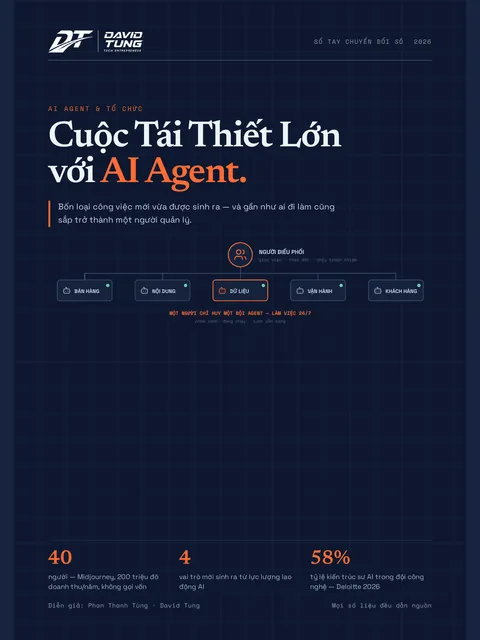
The Great Rebuild with AI Agents
A digital transformation handbook on how AI Agents are rebuilding organizations, creating four new roles, and turning almost every worker into the coordinator of an AI team.
Published: August 15, 2026
“Work is moving from one person doing one task to one person coordinating many tasks done by machines. Start with one repeatable process, define what good looks like, and name the person accountable for the result.”
Summary
- The growth formula is changing: a small, elite team can command an AI Agent workforce that runs 24/7 instead of scaling only through headcount.
- Nano unicorns such as Midjourney, Cursor, ElevenLabs and Gamma show how revenue per employee can multiply when the organization is rebuilt from the ground up.
- Four emerging roles are the Agent Supervisor, Eval Owner, Exception Handler and Human-in-the-Loop reviewer.
- AI can run by itself, but the decision point still needs a named human with clear standards and final accountability.
Table of contents
- 01
The old formula is breaking
Why company capability is no longer capped by employee count
- 02
Evidence: nano unicorns
Hundred-million-dollar companies with remarkably small teams
- 03
The Great Rebuild
Deloitte on rebuilding organizations from the foundation
- 04
Four roles that did not exist before
The new workforce when AI Agents become employees
- 05
Supervision and evaluation
The first two roles in the work of managing machines
- 06
Exceptions and accountability
Why the hardest work still needs human judgment
- 07
Everyone is becoming a manager
Almost every worker will soon coordinate an AI team
- 08
The career map
Four things to do now for the next few years
- 09
For leaders
Nano unicorns are an invitation — and a warning
- 10
Where to start
Three conditions for beginning the rebuild
The old formula is breaking
For a century, revenue and headcount rose together. When one person can command an entire team of “employees” that are AI Agents — software that runs work on its own — company capability is no longer capped by the number of employees.
The new formula is a small, elite team plus an AI Agent workforce. Team size is no longer the only measure of capability. What matters is how many agents one person can supervise and the quality of the criteria they set for the machine.
Evidence: nano unicorns
Investors call them “nano unicorns” — companies generating more than $100 million in revenue with fewer than 50 people, sometimes only a handful. Midjourney reached roughly $200 million in annual revenue with about 40 employees and no outside funding. Cursor went from $1 million to $100 million ARR in less than a year with fewer than 50 people. ElevenLabs reached $100 million ARR in 20 months; Gamma had served more than 50 million users with 28 employees at the beginning of 2025.
The point is not a few exceptional cases. A small, properly equipped team can now reach markets that once required a thousand-person corporation.
“The Great Rebuild” — rebuilding from the foundation
Deloitte calls this shift “The Great Rebuild”: not adding another tool, but rebuilding how an organization is structured, operated and led from the ground up.
Three transitions are underway:
- From human-executed processes to agent-executed processes.
- From departments to coordination capabilities.
- From measuring hours worked to measuring outcomes.
The direct consequence is that roles that did not exist a few years ago are becoming critical positions in the organization chart.
Four new roles in the workforce
Agent Supervisor
Coordinates an entire AI team: assigns work to each agent, monitors execution and intervenes when needed.
Eval Owner
Defines what “good” looks like and measures it. AI can produce output very quickly — but fast and wrong is more dangerous. Without measurement, there is no improvement and no safe delegation.
Exception Handler
Steps into the 10% of unusual or difficult cases where AI gets stuck. The more automation succeeds, the harder and more important the remaining human work becomes.
Human-in-the-Loop reviewer
Stands at the decision point, reviews what AI proposes before it becomes a real action and owns the final accountability. The machine suggests; the human signs; then it becomes action.
Almost everyone is becoming a manager
In the past, only a small group of people became managers of other people. Now almost every worker is — or soon will be — managing an AI team: assigning work, checking it and taking responsibility for it.
You may keep the same job title, but the real work is shifting from “doer” to “coordinator of outcomes”. Delegation, expectation-setting, monitoring and feedback are becoming baseline skills for everyone.
Four things to do now
- Learn to supervise AI, not only use AI. Practice delegating to a team, monitoring it and connecting the results.
- Build evaluation skill. Learn to distinguish “good” from “looks good” using written criteria.
- Move toward the hard work. Tasks AI can do will become cheaper; value will concentrate in judgment, exceptions and accountability.
- Learn systematically. Find a structured path instead of navigating alone in a world whose rules are changing too quickly.
An invitation and a warning for leaders
A small, elite team plus an AI workforce can reach the world — a rare opportunity for Vietnamese startups without requiring massive capital. But if competitors rebuild this way while you do not, the gap will keep widening.
Three conditions for starting the rebuild:
- Choose one repeatable process that consumes the most team time.
- Write down what “good output” means before delegating it to an agent.
- Name one person who owns final responsibility for the result.
Where to start
Do not explore randomly — package the system. The Hermes Agent Coaching path moves from setting up and operating Hermes, to teaching an agent its first task, then automating repeatable workflows, schedules, reporting and multi-agent coordination.
The goal is an agent system fitted to your actual work: you give commands instead of operating every step yourself.
References
The playbook’s claims and figures are cross-checked against Deloitte Tech Trends 2026, The Information, Business Insider, TechCrunch, SiliconANGLE, The New York Times via VC Cafe, VC Cafe, Medium, LinkedIn, Forbes, Harvard Business Review and KPMG. Sources were retrieved on 15 August 2026; some figures change with the source date, and some community terms are not yet fully standardized.
Get the full playbook (PDF)
Leave your email — we'll send the full PDF.